
Résumé
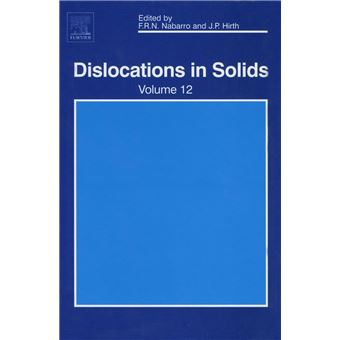
This is the first volume to appear under the joint editorship of J.P. Hirth and F.R.N. Nabarro. While Volume 11 concentrated on the single topic of dislocations and work hardening, the present volume spreads over the whole range of the study of dislocations from the application by Kléman and his colleagues of homotopy theory to classifying the line and point defects of mesomorphic phases to Chaudhri's account of the experimental observations of dislocations formed around indentations.Chapter 64, by Cai, Bulatove, Chang, Li and Yip, discusses the influence of the structure of the core of a dislocation on its mobility. The power of modern computation allows this topic to be treated from the first principles of electron theory, and with empirical potentials for more complicated problems. Advances in electron microscopy allow these theoretical predictions to be tested.In Chapter 65, Xu analyzes the emission of dislocations from the tip of a crack and its influence on the brittle to ductile transition. Again, the treatment is predominantly theoretical, but it is consistently related to the very practical example of alpha iron.In a dazzling interplay of experiment and abstract mathematics, Kléman, Lavrentovich and Nastishin analyze the line and point structural defects of the many mesomorphic phases which have become known in recent years.Chapter 67, by Coupeau, Girard and Rabier, is essentially experimental. It shows how the various modern techniques of scanning probe microscopy can be used to study dislocations and their interaction with the free surface.Chapter 68, by Mitchell and Heuer, considers the complex dislocations that can form in ceramic crystals on the basis of observations by transmission electron microscopy and presents mechanistic models for the motion of the dislocations in various temperature regimes.While the underlying aim of the study of dislocations in energetic crystals by Armstrong and Elban in Chapter 69 is to understand the role of dislocations in the process of detonation, it has the wider interest of studying dislocations in molecular crystals which are ``elastically soft, plastically hard, and brittle''.Chaudhri in Chapter 70 discusses the role of dislocations in indentation processes, largely on the basis of the elastic analysis by E.H. Yoffe. The special case of nanoindentations is treated only briefly.

eBook avec Kobo by Fnac
Des milliers de livres partout avec vous grâce aux liseuses et à l'appli Kobo by Fnac. Une expérience de lecture optimale pour le même confort qu'un livre papier.
En savoir plusAvis clients
Soyez le premier à partager
votre avis sur ce produit
Caractéristiques
- Auteur
- Editeur
- Date de parution
-
août 2004
- Collection
- EAN
-
9780080472546
- ISBN
-
9780080472546
- Type de DRM
-
Adobe DRM
- Droit d'impression
-
Non autorisé
- Droit de Copier/Coller
-
Non autorisé
- Compris dans l'abonnement ebooks
-
Non
- Résumé de l'accessibilité
-
Inaccessible, ou accessibilité limitée connue : Please refer to our disproportionate burden or fundamental modification statements.
Aucune option d’accessibilité au système désactivée (exception)
Navigation dans la table des matières
Unique ordre de lecture logique
Repères de navigation
L’apparence de tout le contenu textuel peut être modifiée
Tout contenu non décoratif accessible aux utilisateurs privés de la vue
Exception 2 EAA – charge disproportionnée : Elsevier is committed to making our eBooks accessible and complying with applicable laws. Given our vast library of titles, there are some cases where making an eBook fully accessible presents unique challenges, and including full features could transform its nature to no longer serve its primary purpose or result in a disproportionate burden for the publisher. As a result this eBook may have limited accessibility. See more at https://www.elsevier.com/en-gb/about/accessibility.
Date de la dernière évaluation d’accessibilité : 20250710
Addenda sur l’accessibilité : https://www.elsevier.com/about/accessibility
Page web de l’éditeur pour les informations détaillées d’accessibilité : https://www.elsevier.com/about/accessibility
- SKU
-
20416195